Economine explainer · the public finances at home
Making ends meet at No. 10
Shrink the UK’s public finances to one household and the bills start to look familiar: a mortgage, the weekly shop, Gran’s pension and a boiler that needs replacing. Can two men at a kitchen table make the money last the week?
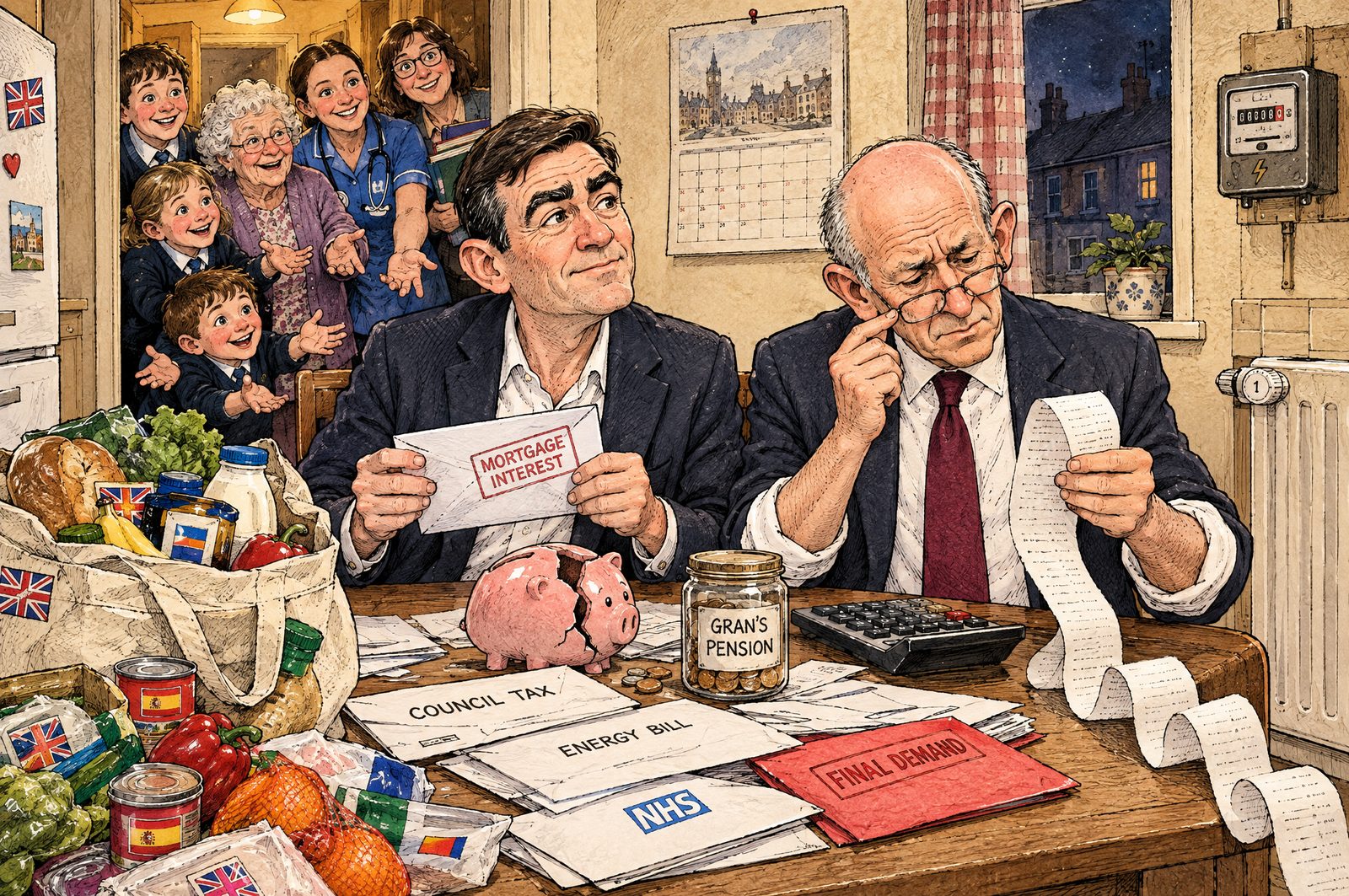
The Andy Burnham-inspired one
Big plans, bigger eyebrows. Believes every problem can be solved by growth, and every growth problem by a new tram line.
The John Healey-inspired one
Owns the calculator. Has read the receipt twice and the small print three times. Wearing a jumper indoors, just in case.
Everyone else
Gran, the kids, the nurse and the teacher. They pay into the house and take out of it, and they notice when the heating goes off.
01 · The kitchen table
This week’s bank statement
Move the dials to change what comes in and goes out. The statement on the right updates as you go. The mortgage interest is locked: the bank sets that, not the household.
| Day | Description | Paid out | Paid in | Balance |
|---|
02 · The obvious question
If they turn the heating down and shop cheaper, can they pay the mortgage?
03 · The serious bit
What the comedy is hiding
The mortgage is the past talking
About a third goes to lenders abroad, so it leaves the house for good. The rest is paid to the household’s own pension funds, banks and savers, and some of it comes back as tax. See net interest by country.
Borrowing for the extension is not the same as borrowing for the shop
The government’s own rule says day-to-day bills should be paid from income, with borrowing kept for the extension. The OBR forecasts that rule being met by 2029–30.
The shopkeeper effect
When the household spends less at the corner shop, the shopkeeper earns less and pays less tax back to the house. So a £10 cut saves less than £10. The page uses the OBR’s original rough multipliers to estimate this for the first year; tick the box under the dials to turn it off.
It works the other way too: tax rises take money out of the dependants’ pockets, and they spend less.
Strip out the interest and it nearly balances
That is why the size of the debt matters more than any one week’s shop: each year’s overdraft adds to the mortgage, and the interest on it, the next.
04 · Where the analogy breaks
Why a country is not really a household
It sets its own pay
A household can ask for a pay rise. A government can vote itself one, by raising taxes, though the dependants have votes too.
The house never dies
A household has to pay its mortgage off before retirement. A country can roll its debts over for ever, as long as lenders believe it will keep paying the interest.
It borrows in a currency it controls
The UK borrows in pounds, and the Bank of England is part of the family. That is very different from a euro country, or a household borrowing from a stranger. See how money works.
The shop belongs to the dependants
When the household cuts back, the people who lose sales and wages are the same dependants it is trying to keep happy. A real family’s spending cuts don’t shrink its own income.
05 · Method and sources
Where the numbers come from
A gently satirical explainer. The characters are caricatures of real politicians for comic effect; the quotes are invented. The figures are real OBR forecasts, regrouped into household lines; the mood and patience meters and the knock-on effects are illustrative, not official estimates. Last checked .